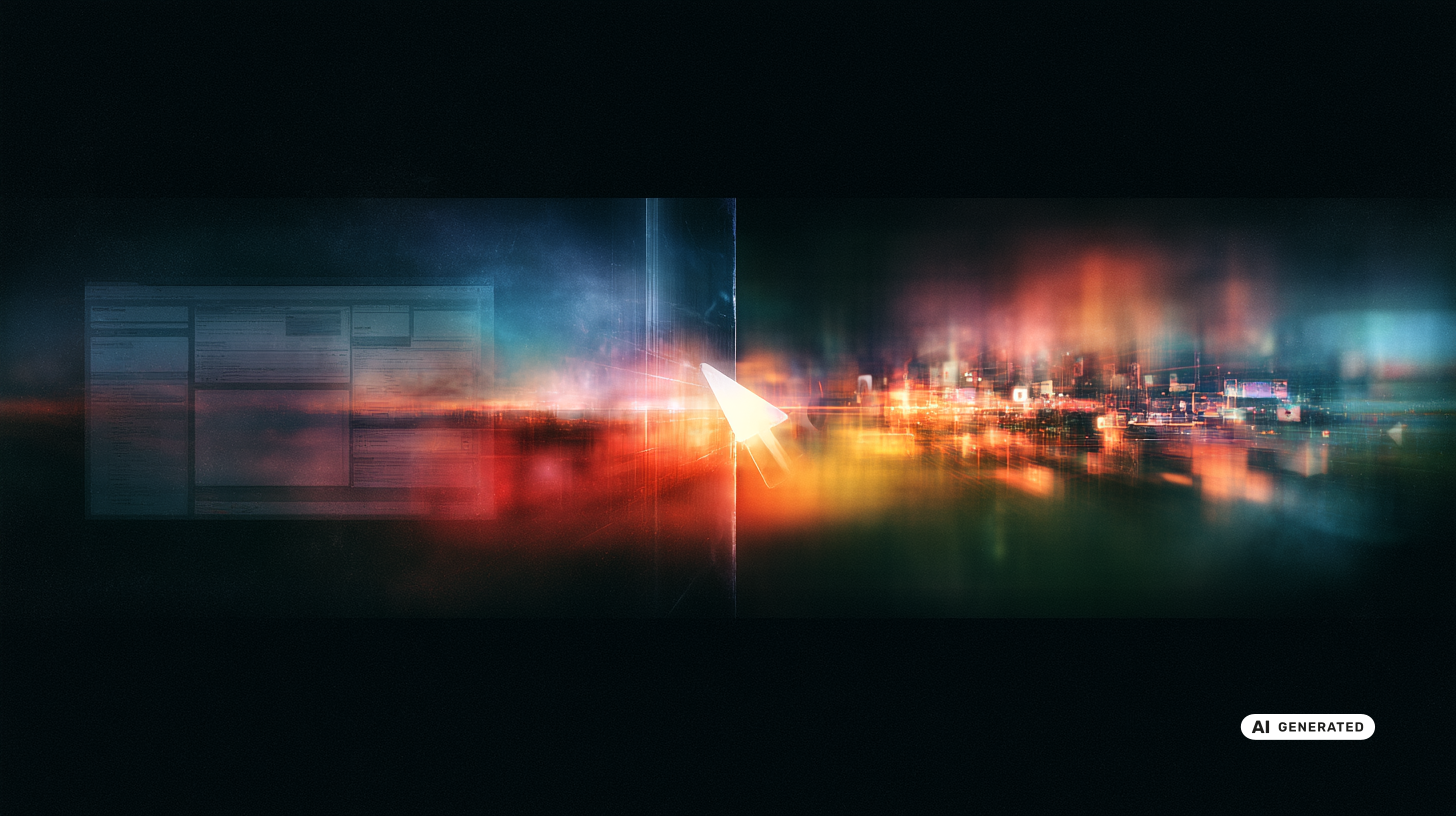
A video editing tool opens — and looks different than it did yesterday. The system has learned from your usage patterns and reassembled the interface accordingly. That’s the idea behind Runway Solaris. But who really decides which tools are visible — the user or the AI?
Runway, one of the most recognized names in AI-driven video production, has introduced Solaris as a concept that reaches far beyond new features. The underlying premise is more fundamental: interfaces no longer need to be built statically. A model can generate them dynamically, adapted to the task, the context, and the user. Whether this represents a genuine paradigm shift or remains a promising prototype for now depends on how the open questions around control, reliability, and accessibility are answered.
What Runway Solaris Actually Does
Traditional software follows a fixed blueprint. Developers decide which buttons go where, which workflows are possible, and how deeply a user can interact with the system. The interface is the product — and it stays that way until someone rebuilds it.
Solaris inverts this principle. Instead of a fixed surface, an AI model generates the interface based on what the user is trying to do at any given moment. Runway describes Solaris as an “Interface World Model” that generates every interface frame and every response to user input in real time, frame by frame, eliminating the intermediate representation layer (e.g., HTML/CSS/JS). (Runway) The interface is no longer a static container — it is itself an output of AI generation.
For creators and production teams, this has tangible implications. Anyone who opens a video editing application today sees the same panels as a beginner and a seasoned editor alike. Solaris promises to dissolve that distinction. The system could present a guided workflow to a newcomer while surfacing exactly the tools an experienced editor needs — without any manual reconfiguration.
Dynamic Interfaces: An Opportunity for Creative Workflows
For video makers, designers, and agency teams, the appeal is clear. Creative work is rarely linear. A project starts with an idea, jumps to research, lands in the edit, and circles back to the concept phase. Static software interfaces handle this kind of movement poorly — they’re optimized for the average case, not for the specific moment at hand.
A dynamically generated interface could change that. Three approaches emerge from the Solaris concept:
Context-adaptive tool selection — The system recognizes which phase of a project you’re in and hides irrelevant functions. If you’re color grading, an audio mixer doesn’t need to be in your field of view.
Learned shortcuts — Recurring actions are prioritized. If you create proxies every day, that step appears prominently without having to dig through menus.
Task-driven layout — The view adapts to the current task: rough cut, fine cut, export — each with its own interface profile.
These aren’t minor improvements. When they work, they significantly reduce cognitive load — especially in high-pressure production situations where every interaction counts. A similar idea runs through the broader conversation about AI-assisted production tools in the film industry: less friction between idea and output is the real promise.
Where Control and Reliability Become the Real Questions
Dynamic interfaces sound like a win for efficiency. But they raise a fundamental question: who holds control — the user or the model?
When software decides which tools are visible, it also decides which options are perceived. In a recommendation system, this is a well-known problem. In a production tool that professional work depends on, it becomes more critical. An editor who can’t find a specific function because the model has deemed it irrelevant loses time — and possibly trust in the entire system.
Reliability is the second open question. Static interfaces are predictable: you know where the button is. Dynamic interfaces can look different every time you open them. That creates friction in teams that collaborate on shared projects and rely on consistent workflows. Tutorials become harder to produce. Onboarding does too.
In the Solaris announcement, Runway notes that Solaris was developed with a focus on real-time interaction, session coherence, and visual quality — and that users can steer the generation through text instructions.
This tension isn’t an argument against the concept, but it is an argument for treating it as what it is: a design with open questions still to be resolved. The way the industry navigates similar control debates around open-source versus closed models makes one thing clear: technical capability alone doesn’t determine adoption. The governance built around it does.
Accessibility: Who Actually Benefits?
Adaptive interfaces have the potential to make software more accessible. The reality is more nuanced.
To benefit from a learning system, you first need to give it enough data to learn from. Users with extensive experience and consistent workflows will be well served early on. Those just starting out, or working irregularly, get a system that hasn’t yet established reliable patterns — and may make incorrect assumptions as a result.
There’s also the question of the underlying data. If Solaris analyzes usage behavior to generate interfaces, questions around privacy and transparency follow. What is stored? Who has access? For how long? For production teams working with confidential material, these aren’t abstract concerns.
Another dimension: accessibility standards. Traditional interface design follows established guidelines — WCAG compliance, screen reader compatibility, keyboard navigation. A dynamically generated interface must meet these standards in every generated state. That’s technically demanding, and Runway acknowledges in the official Solaris announcement that generated interfaces must function with assistive technologies such as screen readers and accessibility APIs.
What This Means for Creators and Production Teams
Runway Solaris marks a point at which software stops being just a toolbox and begins to offer something closer to intelligent support — a system that listens and responds. For creators who work with AI tools daily, this opens up new possibilities.
Adaptive interfaces are coming. The central challenge is how quickly Runway and other developers address the outstanding questions: control, consistency, privacy, accessibility. If you’re already using Runway tools in your day-to-day production work, read Solaris as a preview of a different way of working — not as a finished foundation. The comparison with other AI video ecosystems — such as how Chinese and American models differ in philosophy and control — illustrates that behind every interface approach lies a decision about openness and power.
For your workflow setup, this means: Test Solaris on low-stakes projects first. Document how the system prioritizes your standard tools. And assess whether the consistency between sessions is workable for your team’s way of operating. The technology is genuinely compelling — but only real-world experience will show whether it saves time or introduces new friction.
Sources
- Runway: Introducing Solaris — official announcement and documentation